Cathaoirleach and Members of the Joint Committee, thank you for the invitation to appear before you today as part of your consideration of “Breaking barriers – disability and financial inclusion”.
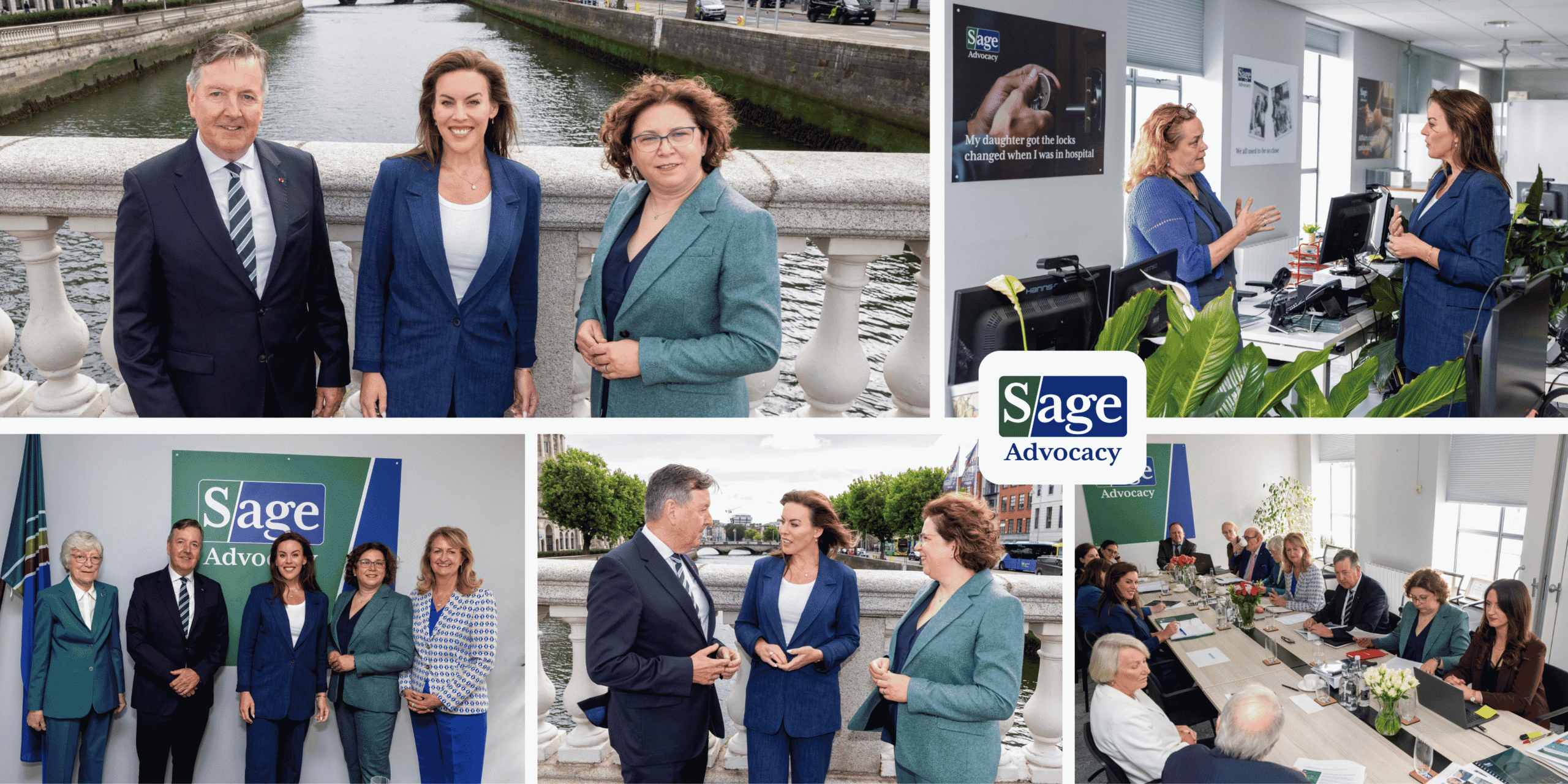
My name is Bibiana Savin, I am the CEO of Sage Advocacy. I am joined here today by my colleagues, Martina Larkin, Legal Support Unit Lead & Helen Fitzgerald, Case Management & Support (Asst CEO).
Sage Advocacy welcomes this opportunity because, in our daily work, we see how financial exclusion is a lived reality for many of our clients whose right to make decisions, access their own money, protect their property, and participate in ordinary life is too often frustrated by systems that are fragmented, risk-averse, inaccessible or slow to respond.
Sage Advocacy is the National Advocacy Service for Older People and Survivors of Institutional Abuse. We provide a free confidential service, independent of family, service providers and system interests. Our motto, “Nothing About You / Without You”, is not a slogan; it is a principle which must be constantly put into practice. It means that the person’s own will and preference must be heard, respected and acted upon, even where their circumstances are complex, even where others disagree, and especially where the person is at risk of being spoken over, ignored, treated as a problem to be managed, or at worst, an asset to be exploited.
In our work, financial exclusion is not abstract. It is the person who cannot get to a bank branch, cannot use digital banking, cannot pass telephone security checks because of hearing, communication or cognitive difficulties, or cannot access their own cash while in hospital or residential care. It is the person whose bank card or PIN is held by someone else. It is the person who is asked for consent in a way that they cannot understand or communicate. The barriers we are discussing today are not one-off personal problems. They are problems which are increasingly clear, patterns.
The scale is significant. In 2025 we dealt with almost 9,000 incoming calls and 3,700 referrals. Our advocates closed over 1,400 cases which had a financial component. We provided detailed data about this to the Committee in our submission. Behind every number is a person, often under pressure, often isolated, and often facing a system that is difficult to navigate even for those with confidence and support.
Financial abuse must be named clearly. It is the misuse, exploitation or theft of a person’s money, property or assets. It can be subtle and very often, the person at risk knows and trusts the person causing the harm. It may be hidden behind dependency, family conflict, institutional silence or assumptions about vulnerability. It is especially difficult to challenge when the person causing concern is also the person relied upon for care, transport, housing, communication or emotional support.
There is now much guidance in place for financial services in how to engage with people who require additional support to stay in control and manage their finances. That is welcome. But Guidance alone is not enough if it does not change what happens at the counter, on the phone, online, in a hospital ward, in a nursing home or in a person’s kitchen. Good practice is still too dependent on the right branch, the right staff member or the intervention of an advocate. Rights should not depend on luck.
Our experience shows that the barriers are real, but they are not inevitable. They are created by culture, policies, practices, assumptions and systems, and they can be changed. Ireland has the legal and policy foundations to do better.
The task now is implementation: ensuring that principles become practice, that guidance includes accountability, and that people most at risk of exclusion are not left to navigate complex systems alone.
Our core messages are simple:
- Accessible, non-digital & supported routes to financial services and public payments must be maintained as core services, not exceptions.
- Third-party and agency arrangements must be subject to stronger safeguards and regular review.
- Frontline staff need consistent training on disability, capacity, supported decision-making & safeguarding.
- Regulators and public bodies must have the tools to monitor whether the guidance available is changing practice on the ground.
- The Criminal Assets Bureau approach of profiling and moving on people with ill-gotten gains, needs to be expanded to include people involved in serious financial abuse.
- Independent advocacy should be recognised, resourced and embedded, not left as an afterthought when harm has already occurred.
We also need to stop treating disability & ageing as separate worlds. Many people acquire disability in later life. Others live with disability throughout their life and grow older within systems that do not recognise changing needs. Survivors of institutional abuse may experience disability alongside re-lived trauma, poverty, isolation and profound mistrust of authority.
Cathaoirleach & members, the true measure of financial inclusion is not how the system works for those who can speak loudly, travel independently, use technology confidently & challenge decisions easily. The true measure is how it works for the person whose voice is quiet, contested, unheard or stifled.
That person has rights. That person has preferences. That person’s money, property and assets belong to them. The State, financial institutions, services and society have a duty to ensure that protection doesn’t become control, that support doesn’t become substitution, and that vulnerability is never used as a reason to silence a person.
Sage Advocacy stands ready to work with the Committee & with all relevant bodies to ensure that those rights are made real.